
Managing high-risk large animal emergencies
August 12, 2026
By Wendy McIsaac
Fire services serving rural and agricultural communities may one day need to rescue animals far exceeding 1,000 pounds. Building muscle memory before the alarm sounds allows crews to manage these high-risk, low-frequency incidents with specialized knowledge and early resource identification.
 A large animal rescue training exercise in Medford demonstrated a simulated ravine rescue. A heavy tow truck is used as part of a coordinated rope rescue system to safely raise the simulated horse, secured in a rescue glide, to stable ground. Credit: Wendy McIsaac
 Talking Points
Firefighters across Canada face unique challenges when responding to large animal emergencies, which require specialized training and preparation. These incidents, often infrequent and complex, can involve horses, livestock, and other animals in distress. Effective response hinges on understanding animal behaviour, scene safety, and having a coordinated plan in place.
- Fire departments invest significant time in training for low-frequency, high-risk incidents.
- Large animal emergencies can pose risks to both responders and animals if not handled properly.
- Preparation and knowledge of available resources are crucial for successful rescues.
This story highlights the importance of specialized training for firefighters to ensure safe outcomes during large animal emergencies, ultimately protecting both animals and their owners in rural communities.


Every firefighter remembers the first time they used hydraulic rescue tools. The first time they practised donning an SCBA. The first time they went into the smoke and flames in the burn tower. Long before arriving at the scene, firefighters trained and developed muscle memory. They made mistakes in an environment where no one’s life depended on the outcome. We would never introduce a firefighter to vehicle extrication for the first time while someone was trapped inside a crushed car on the side of the highway.
So why do we sometimes accept the same approach when the patient weighs 1,000 pounds and has four legs?
We train for the uncommon because when it happens, it is too late to begin learning. Fire departments across Canada invest countless hours preparing for low-frequency, high-risk incidents, including rope, ice and technical rescues, and hazardous materials. These disciplines demand specialized knowledge because we recognize that good intentions alone do not produce safe outcomes.
The reality is simple: the animals don’t know you’ve never trained for this. It doesn’t know whether your department has specialized equipment or if your crew has attended a large animal emergency before. It doesn’t know that this type of call may not be included in your regular training schedule. It only knows that it is frightened, trapped, injured or unable to help itself.
The challenge with large animal emergencies is not a lack of commitment from firefighters. The challenge is that these incidents are often infrequent, highly specialized, and rarely encountered during routine responses. Yet many departments serving rural and agricultural communities will eventually respond to calls involving horses, livestock, agricultural operations or animal transportation incidents. The question is not whether these emergencies can happen, but whether responders will have the knowledge, resources and support needed when they do.

Wendy McIsaac and her horse, Theo. Credit: Wendy McIsaac
Remember: The animal does not understand the plan
The horses aren’t reading our incident action plans. Neither are cattle, poultry or any other animals we may be called to assist. They do not understand our procedures, our equipment limitations or our response strategies.
A frightened animal reacts on instinct. A 1,000-pound animal moving unpredictably can pose significant challenges for responders trying to help. Understanding animal behaviour, recognizing hazards and having a plan before making a rescue attempt are critical components of keeping everyone safe.
One of the most recent rescues I attended involved an 800-pound horse trapped in deep, heavy mud. Half of the horse’s body and both lower legs were encased. The horse also had known flight instincts, which created additional concerns for both the animal and responders.
Working alongside Caledon Fire and Emergency Services, the attending veterinarian, the owner, barn staff and Wellington County Livestock Emergency Response, a plan was developed. Using specialized equipment, including a Nicopolous needle to position rescue straps and mud lances to displace the mud around the horse’s legs, we safely freed the horse. Once moved to stable ground, the horse was rolled over and it stood under its own power.
People often ask what equipment made the rescue successful. While the equipment mattered, the biggest factor was preparation. Everyone involved understood their role and the hazards. Everyone worked together toward the same outcome.

Princess, a young Clydesdale filly, went missing and was later found trapped in a frozen pond near Rockwood, Ont. She was successfully rescued in part by the WCLAER team and the Guelph Eramosa Fire Department. Credit: Wendy McIsaac
The first rescue sometimes prevents the second one
Large animal emergencies elicit a powerful emotional response. Owners love their animals and understandably want to help. That instinct stems from compassion, but compassion without a plan can create additional victims.
In one ice rescue involving a young Clydesdale filly, the owners made the right decision. After discovering their horse had gone through the ice, they called 911 rather than attempting the rescue themselves. That decision protected both the animal and the humans who wanted to save her. The best emergency response often begins with knowing when not to act. If your community knows your fire service has the training and expertise to help, the risk of a secondary response decreases.
My perspective on this was shaped by my horse, Theo. He was more than an animal. He was a trusted partner who taught children to ride, including my daughter when she was young.
Theo was involved in a trailer accident that proved fatal. The incident required careful planning, scene management and technical extraction considerations. Experiencing that call from the owner’s perspective gave me a deeper appreciation for the trust placed in emergency responders during these moments.
These calls are never simply about moving an animal from one location to another. They are about helping people through some of their most difficult moments. Firefighters understand this better than anyone.

Shown here is the aftermath of a multi-vehicle collision involving two horse trailers and a passenger vehicle near Milton, Ont. One trailer was transporting horses, and both horses were ejected during the impact. Credit: Wendy McIsaac
Large animal emergencies come in many forms
When people hear “large animal rescue”, they often picture a horse. Horses are certainly among the most common calls, but I have responded to a variety of animals trapped in mud, ice, fencing, trailers, stalls and equipment. I have assisted with transportation incidents, including an overturned highway transport carrying turkeys. I have responded to agricultural emergencies involving multiple animals and situations requiring specialized extraction. The details change, but the need for preparation does not.
The first five minutes matter
When firefighters arrive at a large animal emergency, the first five minutes can make a significant difference.
Establish scene safety. Before focusing on the animal, responders must assess the environment. Is the ground stable? Is traffic a concern? Are there hazards such as fencing, equipment, water, mud or unstable structures?
Control the scene. Owners and bystanders are often emotional and eager to help. Keeping people safe and organized is critical.
Slow the situation down. A trapped animal creates urgency, but rushing without a plan can increase the risk to both responders and the animal.
Identify resources early. Knowing what specialized resources are available in your community before an emergency occurs saves valuable time. Departments do not need to become rescue specialists, but they should know who can support them.
Remember that the animal is a patient. The goal is not simply to rescue the animal. The goal is to rescue it safely.
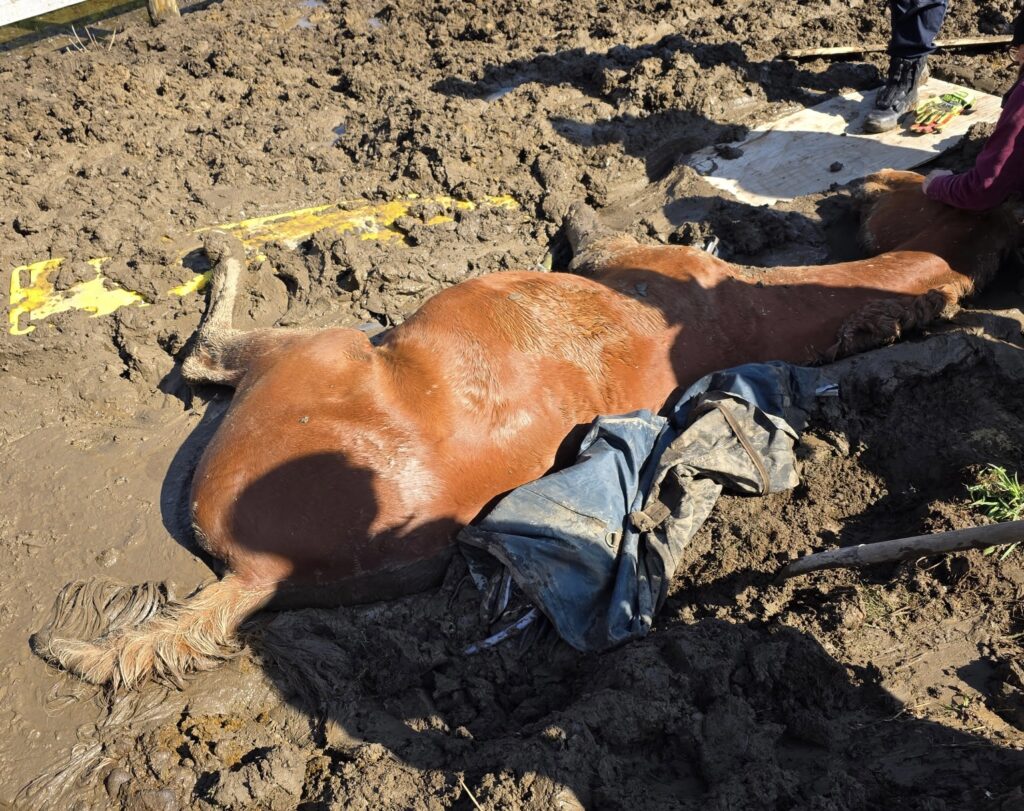
A gelding became deeply trapped in mud near Caledon, Ont. Specialized large animal rescue equipment and techniques were used to safely free the horse. Credit: Wendy McIsaac
Preparation before the alarm
Nobody expects every firefighter to become a Technical Large Animal Emergency Rescue (TLAER) specialist. However, every firefighter deserves enough awareness so that when the call comes in, their first thought is not “I have never done this before.” Technical Large Animal Emergency Rescue is not about replacing the skills firefighters already possess. It is about adding another layer of preparedness for the communities they protect.
The call we never train for is often the one that tests us the most. So ask yourself: If the tones dropped tomorrow for a large animal emergency, would your crew know where to start?
Wendy McIsaac is a fire and life safety educator, NFPA-certified fire inspector and instructor, and founder of Wellington County Livestock Emergency Response (WCLAER). She has worked alongside fire departments, veterinarians and emergency responders during technical large animal emergencies throughout Ontario. Wendy is passionate about improving firefighter safety through education, preparedness and interagency collaboration and regularly presents on Technical Large Animal Emergency Rescue (TLAER) and agricultural emergency response.